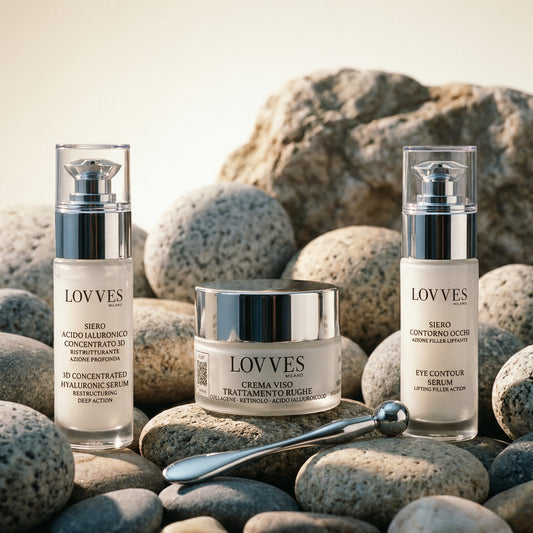
For neck wrinkles, cream or serum are not mutually exclusive alternatives: a serum can offer targeted treatment, while a cream mainly supports comfort and the skin barrier. For many people, they work well together, along with daily sun protection. Cosmetics can improve hydration, smoothness, and the appearance of fine lines, but they do not eliminate deep folds or pronounced sagging.
The choice depends on the skin and the goal
The neck has relatively thin skin and may be more reactive than the face. Horizontal lines can result from dehydration, repeated movements, sun exposure, skin characteristics, and the natural changes in tissues over time. For this reason, choosing a product based on texture alone is rarely the answer: the formula, consistency of use, and tolerability matter more.
A cream is generally the first choice if the neck looks dry, feels tight after cleansing, tends to flake, or becomes irritated easily. Emollient and humectant ingredients help reduce the feeling of dryness and temporarily make lines associated with dehydration less visible. It is also the simplest format for those who want an essential routine.
A serum can be useful when you are looking for a specific active ingredient and prefer a lightweight texture. It is not automatically more effective than a cream: this depends on the formula and on the skin's ability to use it consistently without becoming red. If a serum is applied, following it with a cream can limit water loss and make the routine more comfortable.
When to prefer a neck cream
A face cream can often be extended to the neck and décolletage, provided it does not cause burning or irritation. It is not essential to buy a product labeled exclusively for this area. A good daily cream is especially practical for those who want to support hydration without adding too many steps.
Looking for ingredients such as glycerin, hyaluronic acid, ceramides, squalane, panthenol, or other emollients can make sense when the priority is softer, smoother-looking skin. Topically applied hyaluronic acid acts mainly as a humectant: it does not fill deep wrinkles, but it can improve the appearance of superficial lines when the skin is dehydrated.
Richer textures are often preferable in the evening or during colder months. If, on the other hand, you are very sensitive to heat or dislike the feeling of product on your neck, a fluid lotion or gel cream may encourage consistency. The best product is the one you enjoy applying every day.
When a serum can be a good addition
A serum is suitable if you want to pair a targeted active ingredient with your cream while maintaining a lightweight texture. Formulas with peptides, niacinamide, or antioxidants can be a reasonable cosmetic option for a routine focused on skin quality. However, it is sensible to expect gradual and mainly aesthetic changes, not a transformation of already established grooves.
Vitamin A derivatives, including retinol in cosmetics, are often chosen in routines for signs of aging. They should be introduced more cautiously on the neck than on the face, because they can cause dryness, stinging, and redness. Start with infrequent applications and stop if the skin remains irritated. During pregnancy or breastfeeding, it is advisable to ask a doctor for advice before using products with retinoids.
Chemical exfoliants can make the skin smoother in some routines, but they are not essential for neck wrinkles. Using them together with a retinoid or on already sensitive skin increases the risk of irritation. For this delicate area, simplifying is often more useful than layering many active ingredients.
The most useful routine: protection, hydration, and gradual introduction
Protection from UV rays is a key step in the cosmetic care of the exposed neck. A broad-spectrum sunscreen, applied in the morning to the neck and décolletage when these areas are uncovered, helps prevent further visible damage related to exposure. No anti-wrinkle cream reliably makes up for repeated unprotected sun exposure.
- Cleanse the neck with a gentle product, or allow it to be cleansed with thoroughly rinsed facial cleanser.
- In the morning, apply a hydrating or antioxidant serum only if desired and tolerated by the skin.
- Apply a moisturizing cream using gentle movements, without rubbing vigorously.
- Apply sunscreen to the exposed neck and décolletage, allowing the previous layers to dry.
- In the evening, use cream alone or a targeted serum followed by cream; introduce a retinoid gradually.
Waiting briefly between layers can make application more pleasant, but a complex procedure is not necessary. If you have sensitive skin, choosing only one new product at a time makes it easier to understand whether a formula is well tolerated.
Common mistakes that can worsen skin comfort
- Applying the same strong active ingredients used on the face to the neck at the same frequency, without an adjustment period.
- Using harsh scrubs, brushes, or vigorous massage in the hope of “smoothing out” wrinkles.
- Alternating many exfoliating serums, retinoids, and fragranced products on an already dry area.
- Treating the neck only in the evening and forgetting sunscreen when it is exposed.
- Abandoning the routine after a few days: cosmetic benefits require consistency, not intensive use.
A very gentle massage may feel pleasant during application, but it does not permanently change the structure of wrinkles. Maintaining more varied posture while using screens can also be a comfortable habit, without turning it into a promise of total prevention of horizontal lines.
What results to realistically expect
With a suitable routine, neck skin can look more hydrated, smooth, and radiant; fine lines related to dryness may appear less noticeable. Results depend on the skin's initial condition, sun exposure, the formula, and consistency. Assessing changes under the same lighting conditions after several weeks of regular use is more useful than checking every day.
Deep wrinkles, pronounced skin laxity, and folds present even at rest have limits that skincare cannot overcome. If changes are rapid or accompanied by persistent itching, redness, lesions, or discomfort, it is preferable to consult a dermatologist. A professional can distinguish a need for skin care from a condition that warrants medical assessment.
FAQ on cream and serum for neck wrinkles
Can I use the same face cream on my neck?
Yes, in most cases. Extend the cream from the face to the neck and décolletage if the texture is comfortable and does not cause irritation. If you use potentially sensitizing active ingredients on your face, such as retinoids or acids, it may be safer to apply them less often on the neck or choose a gentler formula.
Should serum be used before or after cream?
As a rule, serum is applied before cream, on clean, dry, or slightly damp skin according to the product instructions. The cream follows to complete hydration. If you want a minimal routine, you can choose one of the two: a good cream with sunscreen in the morning remains a very practical step.
How long does it take to see results?
Relief from dryness may be noticeable quickly, while a more even appearance of fine lines requires consistent use for a few weeks. There is no identical timeline for everyone, and it is not realistic to expect a cosmetic product to erase deep wrinkles. If a product causes irritation, do not persist in an attempt to achieve results faster.
A simple criterion for getting started
If you need to choose just one product, start with a comfortable cream and sunscreen in the morning. Add a serum only if you have a specific goal, such as greater hydration or the gradual introduction of an active ingredient, and if your skin remains calm. A short, gentle, repeatable routine is more useful than aggressive layering.